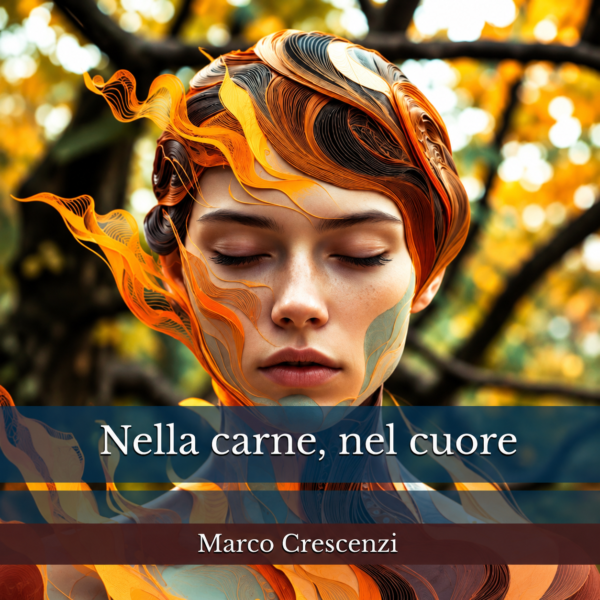

I recently published Nella carne, nel cuore (In the Flesh, in the Heart).
A book in which I sought to weave together reflection, poetry, and short narratives, adopting a poetic style to explore—from different perspectives—emotions, intuitions, and thoughts. This publication also became an opportunity to reflect once again on the meaning of writing, and more specifically, of writing poetry.
I am passionate about art and literature, but my education and professional background are scientific and technical. I have worked for many years in technological environments, immersed in innovation and research. Alongside this world, however, I have always cultivated writing. For me, writing is a liberating act—one that gives depth to experience. Poetry, in particular, is a space of listening and truth. I believe it can be valuable also for those who work in scientific and technological fields, where thinking is often oriented toward structure, solutions, and efficiency.
Engaging with poetry
Poetry is not an immediate literary form. Perhaps this is why poetry books are often short: the text asks to be reread, inhabited, and crossed through.
For those who appreciate certain rituals, the experience can resemble sipping an intense whisky: it must be tasted slowly, without haste. Or like observing a painting, where the gaze moves between detail and the whole, allowing itself to be warmed by colors and shapes.
Publishing poetry is always a challenge. It is not fast entertainment, nor a linear narrative. It requires attention, openness, and involvement. The rhythm, the musicality of words, and their symbolic weight lead the reader into a different dimension—more fragile and more profound. At times, readers try to “decode” the poet, when perhaps it would be enough to let themselves be carried by images, sounds, and atmospheres.
In the preface to Il sentiero sull’acqua (The Path on the Water), I asked myself what poetry can still say today to readers overwhelmed by words, messages, and constant content. We continue to ask poetry to open spaces, to evoke meaning, to create deep resonances. We search, as Montale wrote, for “the word that shapes from every side our formless soul,” and for what the author of On the Sublime called “resonance with a great soul.”
Poetry is not dead
Poetry is not dead. We seek it in songs, in verses that stay with us without our knowing why. We all feel the need for moments of truth to be lived with vulnerability.
In Nella carne, nel cuore I wrote:
We live in a time that needs poetry.
But, in truth, every time needs poetry.
We need words that lift us out of time,
to understand—and then to love—our time.
In a world that moves fast and often reveals the harsher side of our humanity, poetry introduces a different kind of energy. It creates space.
Perhaps this is its deepest meaning: helping us live with greater intensity and depth. Helping us, quite simply, to be more human.