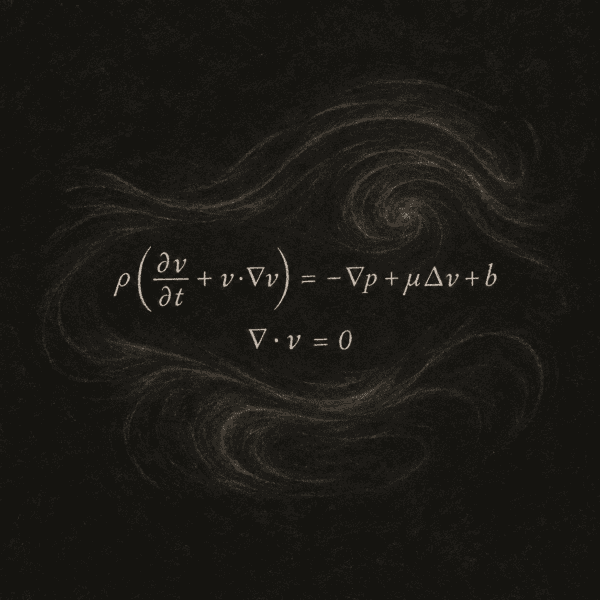

ρ(∂v/∂t + v·∇v) = -∇p + μΔv + b
∇·v = 0
An ornate enclosure
A perfect description
The formal elegance of movement
The mystery of the real
The immense creativity of life
Movement held in a fist
A comforting explanation without solutions
(from “Il sentiero sull’acqua,” The Path on the Water)
A news item, these days, has struck me — or perhaps I should say unsettled me: it was like seeing, in a newspaper or on television, the photo of an old friend or an old flame. A blow to the heart that reopened a box full of memories, in an attic of my mind. OpenAI announced it had made an enormous step on one of the most celebrated problems in mathematics: the Navier-Stokes equations, which describe the motion of fluids — water flowing, air wrapping around a wing, blood moving through our veins.
An Equation Nearly Two Hundred Years Old
Nearly two hundred years ago, Claude-Louis Navier — a French engineer, among the first to bring the rigor of mathematical calculation to bridge design — and George Gabriel Stokes — an Irish mathematician and physicist who held, for almost forty years, the Cambridge chair that had once been Newton’s — tried to describe mathematically the chaotic motion of fluids: the equations, sketched out by Navier in 1822, took the form we know today thanks to Stokes’s corrections some twenty years later. These are equations still used every day by everyone from aircraft designers to climatologists — no one doubts that they work. What remains an open problem is whether they always admit, in every case, a physically sensible solution: it’s one of the questions gathered under the seven “Millennium Prize Problems,” the ones for which the Clay Mathematics Institute offers a million dollars to whoever solves them. For nearly a century, no one had ever managed to answer it in full.
The Memory of an Almost Sacred Mystery
The news touched me deeply, for several reasons. I’m an aerospace engineer: I studied those equations at University La Sapienza, and reading the news I relived feelings from that time, in the classrooms of the San Pietro in Vincoli faculty, on Colle Oppio, in Rome. In those years, while I was trying to grasp the secrets of the wind to make it my life’s profession, I found in the Navier-Stokes equations an almost obsessive formal beauty, coupled with the discovery that no one knew — and in part still doesn’t — whether a smooth, well-defined solution always exists for the general case. An elegance wrapped in the mystery of its own unsolvability.
The discovery of an almost sacred mystery, made — not by chance, I like to think — in a faculty built out of a former convent, on a hill whose sacredness was already recognized in archaic times: it’s said the area was once linked to an ancient sacred beech grove, and that in later centuries some of the most celebrated monuments of antiquity rose there — Nero’s Domus Aurea, the Baths of Titus and Trajan, the villa of Maecenas. Those feelings stayed with me for years, so much so that they gave rise to the poem that opens this post, later included in the collection Il sentiero sull’acqua (The Path on the Water).
When I read the news, my first thought was: that mystery has dissolved. But reading more carefully, the matter is more subtle — and, thinking about it, even more fascinating than I first took it to be.
What OpenAI Actually Proved
Here, though, precision matters, because what was actually proven isn’t quite what the headlines suggest. The Navier-Stokes equations, at bottom, do nothing more than apply Newton’s law to the continuum of a fluid — F = ma, a force equal to mass times acceleration — while leaving room for an external force that can stir it. For nearly a century mathematicians have tried to prove one of two things: that, starting from reasonable conditions, the solution always stays smooth — physically plausible, well-behaved at every point — or that there exist conditions under which the equations instead produce a result with no physical sense. OpenAI didn’t prove the first. It proved the second, in one precise case: starting from a perfectly “calm” fluid, with no trace of turbulence, they showed that a vortex can tighten in on itself and stretch out like an ever-thinner strand of spaghetti, until it reaches, in finite time, infinite velocity at a single point. Nothing in reality can move at infinite speed — not even light. That’s the moment when the mathematics of the problem stops working: the solution, perfectly regular an instant before, breaks down.
This doesn’t mean the equations are wrong, only that they’re incomplete: they treat the fluid as a smooth, continuous medium, while every real fluid is made of discrete atoms and molecules. The result suggests that, starting from the Navier-Stokes equations alone, one can construct a scenario in which they wander outside their own range of validity — and at that point some other physics has to step in, the kind that in reality keeps infinity from ever actually showing up. It is, if you like, the “ornate enclosure” that admits, at its own edges, a gap.
A Race, and a Dispute Over Credit
How they got there is striking too. OpenAI’s agents first tackled a simpler cousin problem — the Euler equations, which ignore viscosity — finding a solution with a thousand agents over fifty hours of work; then they scaled up, with ten thousand agents, to attack the full Navier-Stokes equations, arriving at a solution within a few days and formally verifying it, line by line, within twenty-four hours. The whole effort cost, by the company’s own admission, several million dollars — a figure that, calculated on the actual computing cost incurred, comes close, in a curious twist of fate, to the very million dollars offered by the Clay Institute. And it wasn’t a pure exercise in scientific ambition: OpenAI admitted it launched the effort after hearing rumors that a competitor — Anthropic — might be close to solving not one, but two Millennium Problems.
That very rivalry sparked a dispute that adds a more human, and less comforting, dimension to the story. For about a year, mathematician Tristan Buckmaster (New York University) and Levent Alpöge, a researcher affiliated with Anthropic, had been working in a personal, self-funded collaboration on the same terrain, turning what Buckmaster publicly called “AI slop” — a rough draft produced by artificial intelligence — into a readable proof. When they let it be known they were about to publish, according to Buckmaster’s account OpenAI offered him sole authorship of the result on condition that Alpöge’s name disappear from the work: an offer he refused. OpenAI denies having had access to their work before publication, while not ruling out that anonymized data from their use of its tools may have indirectly influenced the training of its models. A question that remains open.
A Mystery That Changes Shape
This, I think, is the real point. The mystery hasn’t dissolved: it has shifted. The question “does a solution always exist?” remains open. What has changed is that we now know, backed by a formal proof, that the smoothness of the real can break — that even at the heart of so elegant an equation lies the possibility of collapse. “Without solutions,” I wrote years ago, thinking of a limit to human knowledge. Today that phrase has an even more literal meaning: not that an explanation is missing, but that the solution itself, at a certain point, can simply cease to exist.
What Remains Human
On one hand, all this is genuinely hopeful for the future. If a network of artificial agents can, in a matter of days, produce and verify a result on which generations of mathematicians got stuck, then artificial intelligence really could help us push forward the frontier of complex problems — OpenAI’s own researchers already speak of new materials and disease cures as possible next frontiers, not just theorems. On the other hand, the same episode opens up a new scenario: if AI starts solving — or breaking — the mysteries we thought were ours, perhaps it’s simply moving us toward mysteries of a different order — about what it really means to prove something, about who deserves the credit, about how much of a discovery remains comprehensible to a human mind that can never read, all at once, the lines of a formal verification as long as a novel.
Either way, something will remain that no artificial agent can compute in our place: the capacity to stop in front of a vortex tightening in on itself and to feel, for a moment, inside the mystery — not outside it, observing.
It is the most human part of us, faced with the creativity of a mathematical model that, in its geometric perfection, seems almost a work of art by Michelangelo — like the Moses that stands in San Pietro in Vincoli, in the basilica beside the cloister where the faculty in which I studied those very equations stands today.
We will keep marveling at the discoveries of mathematics and physics, born of our own intuition, and perhaps keep writing poems about equations long after the equations have stopped amazing us as problems — because what we have always sought in them was never only the solution.